
Financing Mutual Aid:
The next scalable frontier for humanitarian action, or another approach the humanitarian system is ill-equipped to support
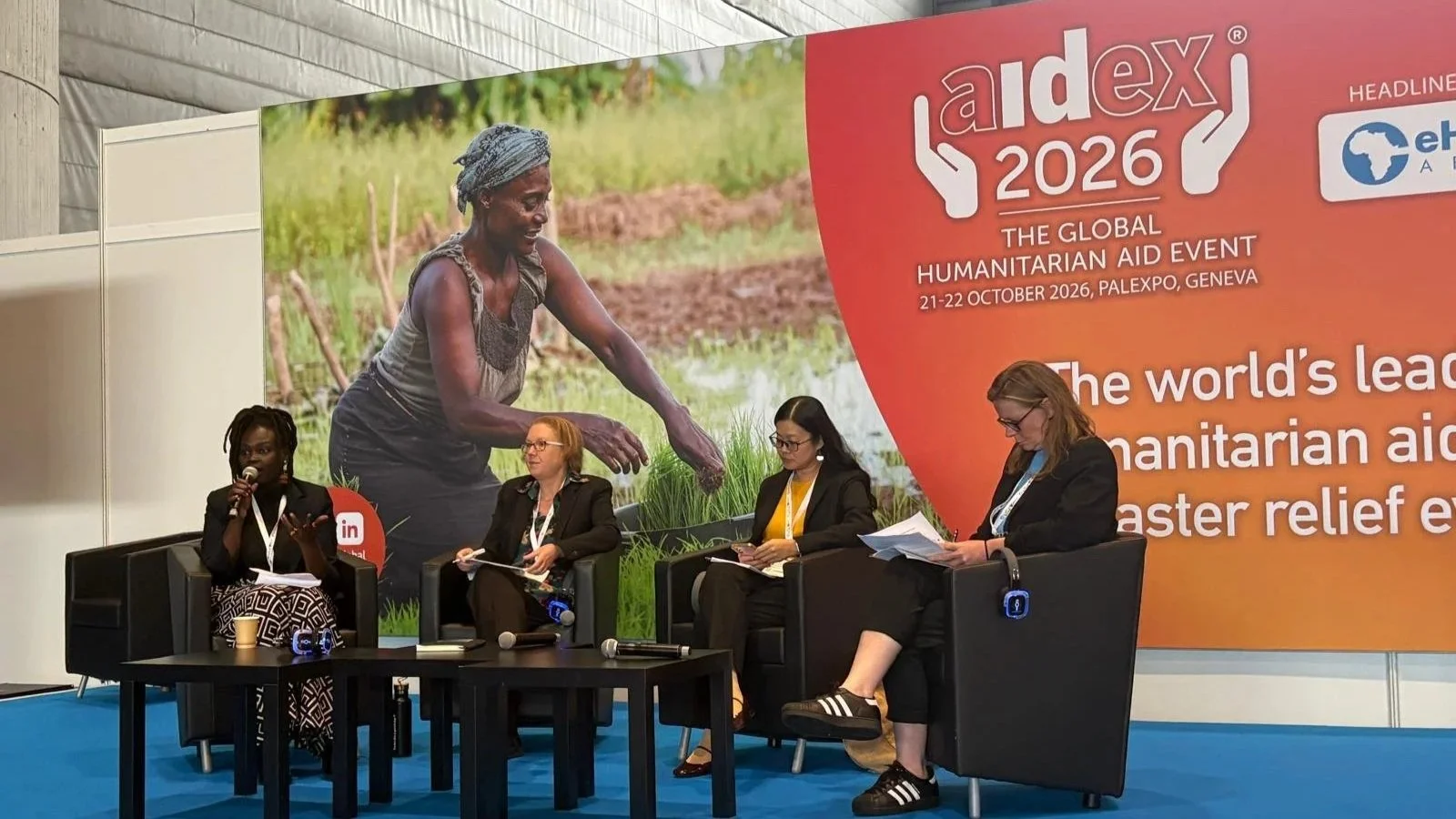
On 22 October, the Global Resilience Fund (GRF) at Purposeful facilitated a discussion at AidEx Geneva exploring how humanitarian funding can strengthen mutual aid while protecting its independence, flexibility and community ownership.
Moderated by Aluel Atem, the Global Resilience Fund’s Crisis and Humanitarian Advocacy Manager at Purposeful, the panel brought together Howida Minallah of Sudan’s Emergency Response Rooms; Nafissatou Hassane Alfari, Co-founder of Women in Nexus Niger; Kate Moger, Deputy CEO of Resilio Fund; Juliet Parker, Director of ALNAP; and Wei San Lee, representing Women’s Fund Asia and the First Response Fund.
The conversation began with a visible contradiction. Visa challenges had prevented Howida and Nafissatou from attending in person. Both joined remotely, speaking into a space where local leadership was being championed while their own access remained restricted.
For Aluel, their absence raised a question that extended beyond the panel: who can participate in the rooms where humanitarian priorities are discussed and decisions are made?
She situated the discussion within a much longer history of communities organising to support one another:
“Mutual aid is not new. A lot of communities across the globe have been practicing mutual aid in different ways, different shapes, different contexts to respond to crises and care for one another. Mutual aid is rooted in relationships. It’s rooted in community care. It’s rooted in the willingness of how communities practice and show up for each other” — Aluel Atem, from the Global Resilience Fund at Purposeful
Drawing on her Global Resilience Fund work moving flexible resources directly to girls and young feminists responding to crises, she also advocates for greater recognition and support for their leadership. Aluel framed the discussion around the relationships that make mutual aid possible, asking what happens when external resources enter those relationships.
Her questions gave the panel a shared challenge: how can humanitarian actors support this work on communities’ own terms? The experiences shared from Niger and Sudan brought that question into focus.
Starting with the people already responding
Nafissatou Hassane Alfari from Niger grounded the conversation in the everyday actions of communities welcoming people displaced by insecurity and climate-related crises. Families arriving in a village may find their first support through neighbours sharing land, food, clothing and access to water, healthcare and schools.
“The first response does not always come from an actor officially recognised as a humanitarian organisation. Organisations may be present, but the first help often comes from communities.” — Nafissatou Hassane Alfari from Women in Nexus Niger
Her contribution also drew attention to the needs of host communities themselves. When displacement lasts for months or years, sharing resources becomes a sustained responsibility. Recognising that contribution means asking what support these communities need to continue caring for others without exhausting their own resources.
For Nafissatou, funding must strengthen the solidarity already sustaining these responses while respecting communities’ ownership and the limits of what they can carry.
“The question is how we support community solidarity without changing its meaning or taking control, and without transferring to communities the responsibilities that humanitarian actors must fulfill.” — Nafissatou Hassane Alfari
Community solidarity, sustained on its own terms
Howida Minallah brought the experience of Sudan’s Emergency Response Rooms into the discussion, describing a response rooted in longstanding traditions of mutual support. Communities have drawn on these practices during the war to help one another survive, with volunteers taking on responsibilities the state has been unable to fulfil.
“The Emergency Response Rooms are not simply a mechanism for distributing shelter materials or food. They are interconnected survival networks and centres of community management, taking on roles that the state has been unable to fulfil.” — Howida Minallah from Sudan’s Emergency Response Rooms
Howida recognised the volunteers carrying out this work under bombardment and security restrictions, many while urgently needing assistance themselves. She also highlighted women and young women as key actors in the response, organising and sustaining services within their communities.
External funding can strengthen these efforts, helping volunteers organise and supporting grassroots initiatives. But Howida urged funders to judge their contribution by what it enables communities to do and the independence it preserves.
“External funding cannot be measured by the volume of assistance alone. It is measured by how it strengthens communities’ capacities while preserving their independence in carrying out their roles.” — Howida Minallah
The Emergency Response Rooms began through community solidarity before external assistance arrived, and their networks have spread even to places funding has not reached. Supporting them requires donors to coordinate with the people already managing protection, health, education and other services, allowing communities’ priorities to guide funding decisions.
“Funding does help volunteers and youth initiatives organise. But it requires some coordination with grassroots initiatives so they can identify their needs and priorities, and donor interventions can be based on those.” — Howida Minallah
Her contribution made clear that financing mutual aid carries responsibilities: sustain the work, respect grassroots decision-making, and ensure donor interventions respond to the needs communities themselves identify.
The role of funders looking to support mutual aid
Building on Nafissatou’s and Howida’s contributions, Aluel asked how money could enter mutual aid without becoming what holds it together.
How could funding preserve its foundations of solidarity, community care and reciprocal support?
Kate Moger challenged the assumption that external funding creates the relationships that sustain mutual aid. Communities contribute their own time, energy, money and resources long before a grant arrives. Funding enters relationships and practices that already exist.
“When a crisis hits, communities are already responding and contributing enormous amounts of their own time and energy, money and resources.” — Kate Moger
Drawing on Resilio Fund’s emerging evidence, Kate explained that for every $1 given by external funders like Resilio, communities were contributing roughly 50 cents through their own cash and in-kind support. This matching of resources means that external funding adds to a much larger collective effort.
This recognition changes a funder’s role. Kate described Resilio’s approach as “moving capital with care”: responding quickly while remaining conscious of the power that accompanies money.
Drawing on an example from the Democratic Republic of the Congo, she described working through an established feminist funding network whose relationships and contextual knowledge enabled it to shape its own response.
“We as an external funder trusted them to dream, to design, to deliver a response that made sense to them based on their understanding of that context. So our role is to make … resources available and not prescribe how they should be used.” — Kate Moger
Her response to Aluel’s question placed trust in practical terms: make resources available and allow the people experiencing the crisis to decide how those resources can strengthen what they are already doing.
What needs to grow is the capacity to support
Juliet Parker shared emerging insights from ALNAP’s research with national research organisations on the relationship between formal humanitarian institutions and mutual aid.
Flexible support can help communities, she explained, particularly when funders respond to their priorities, share risk and relinquish control over decisions. But external resources can also change relationships, priorities and the ways decisions are made.
That makes the language of “scaling mutual aid” worth examining.
“The distinction between scaling mutual aid itself … and scaling support to mutual aid. Mutual aid is already infinite. It exists everywhere. It does not need scaling. That’s not the question. The question is: can humanitarian actors scale their own capacity to recognise, connect with, and appropriately support the forms of collective action that already exist?” — Juliet Parker
Juliet described examples of individuals and institutions acting as protective buffers between mutual aid networks and the demands of the international humanitarian system. These efforts can make support possible, but they also reveal how much still depends on people finding ways around institutional rules.
“We’re in a kind of era of workarounds at the moment, where people are cunningly finding ways to navigate and protect what’s important about mutual aid approaches.” — Juliet Parker
The larger question, she argued, is whether international actors are prepared to challenge and change their own practices. Lasting change requires organisations to examine the requirements they impose and the power they retain.
Funding the relationships that make response possible
Aluel pushed the conversation beyond how funding arrives to the responsibilities funders carry when it ends.
“What responsibility do funders have for what happens after the funding ends, and how should that shape the way support is provided from the beginning?” Aluel asked.
Wei San Lee’s response placed individual humanitarian grants within a longer relationship of support. She explained how the First Response Fund works through women’s and feminist funds already connected to grassroots organisations. Humanitarian resources reach groups through relationships that also provide core funding, accompaniment and other support.
“We’re not looking at short-term crisis response only. Feminist funds are already providing core support, accompaniment support, all of the other kind of holistic, multi-layered support that grassroots organizations are asking for.” — Wei San Lee
This approach also helps protect core resources from being diverted to humanitarian activities that dedicated crisis funding could cover. An emergency grant becomes one part of the support available to an organisation, within a relationship that extends beyond the immediate response.
Wei San also highlighted a recurring request from partners: fund their networks and their relationships. Those connections allow organisations to exchange information, identify needs and reach communities through people they know and trust.
“Once you fund these networks and their connections and that kind of resilience building among groups, you already have an infrastructure in place.” — Wei San Lee
Her response offered a direction for the responsibility Aluel raised: invest from the beginning in the relationships and support that sustain community organising beyond an individual grant. Although the discussion did not set out a specific process for ending funding, it showed why responsible financing must look beyond the grant period.
Sharing power without transferring the burden
Throughout the discussion, speakers returned to the responsibilities of humanitarian institutions and governments.
Recognising community leadership must not become a reason to expect people already living through crises to carry more responsibility without adequate resources or protection. Aluel made that boundary explicit:
“Mutual aid cannot solve all the humanitarian problems, and it cannot be the new system that the humanitarian system wants to transfer to the communities that are already burdened.” — Aluel Atem
Juliet reinforced the need for different actors to fulfil distinct, complementary roles. Community networks bring contextual knowledge, relationships and trust. Formal institutions retain duties that cannot simply be passed to volunteers.
“It would be absolutely inappropriate to expect volunteer networks to take on financing major infrastructure, providing specialized services, assuming responsibility for protection. It would not be okay or workable.” — Juliet Parker
An audience contribution sharpened this concern: could growing interest in mutual aid turn it into another inexpensive way to extend humanitarian coverage, while leaving the distribution of power untouched?
For us at The Global Resilience Fund at Purposeful, these questions connect directly to the recognition and resourcing of girls’ and young feminists’ crisis response efforts. Supporting their leadership requires funding that respects their decisions, invests in their relationships and responds to the realities they face.
Aluel’s questions kept those responsibilities in view throughout the conversation: what should grow, who should decide, and what remains when a grant ends? Across the panel, the responses pointed towards funding that strengthens existing solidarity, supports lasting relationships and leaves communities with the freedom to determine their priorities.
The discussion at AidEx left humanitarian actors with a concrete challenge: change the conditions under which support is offered.
Make resources accessible, share decision-making power, and take responsibility for how funding affects the communities receiving it. That is where commitments to community leadership must become practice.